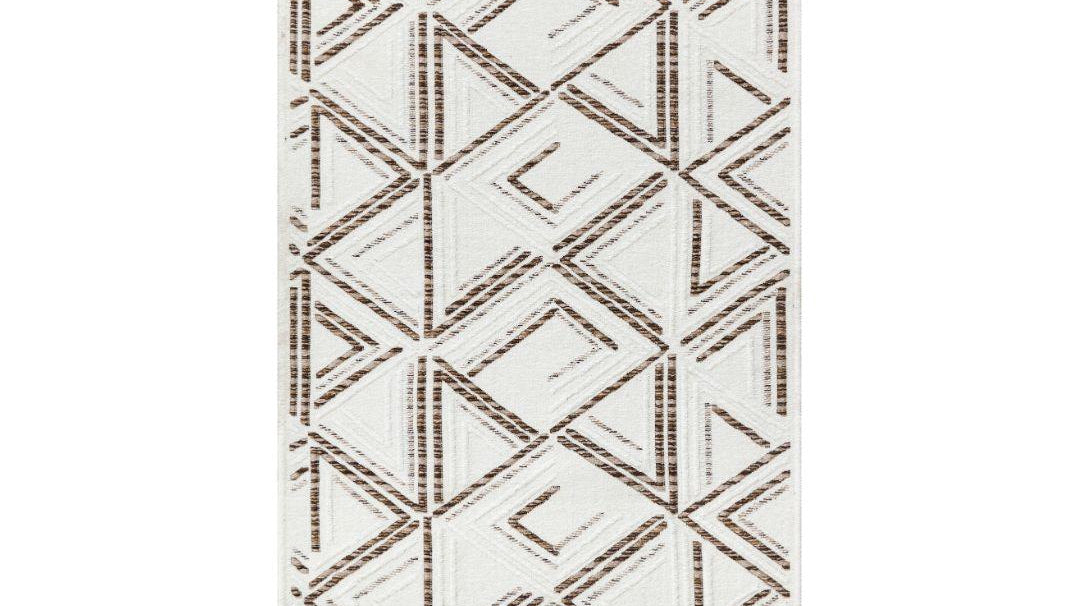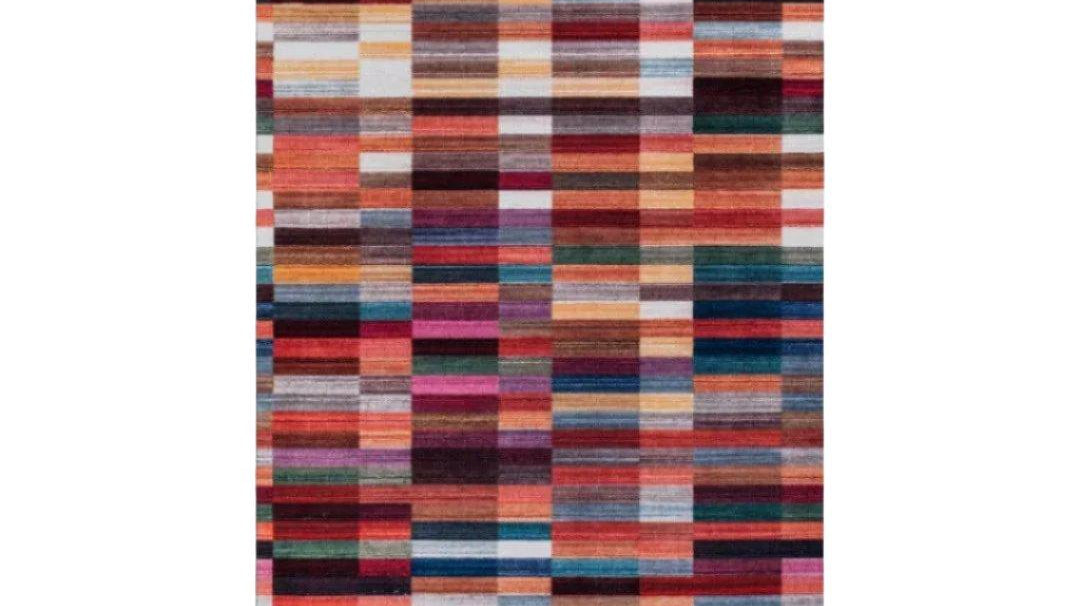

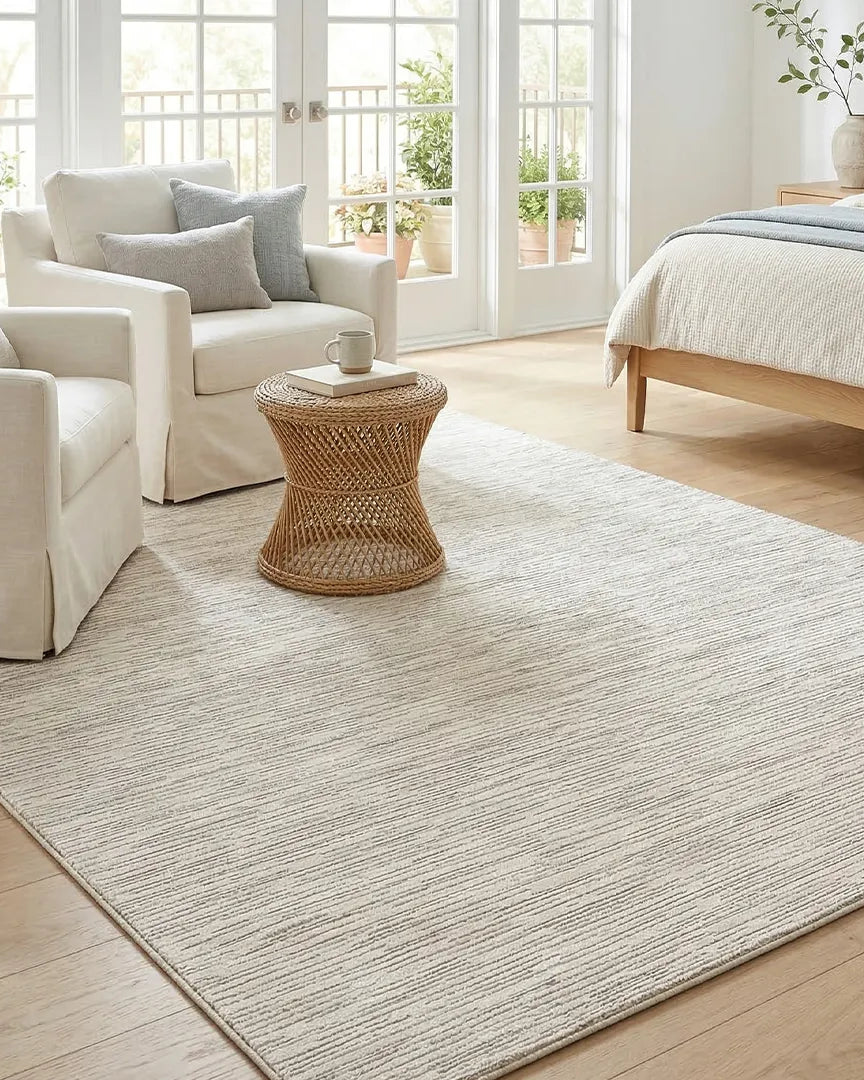



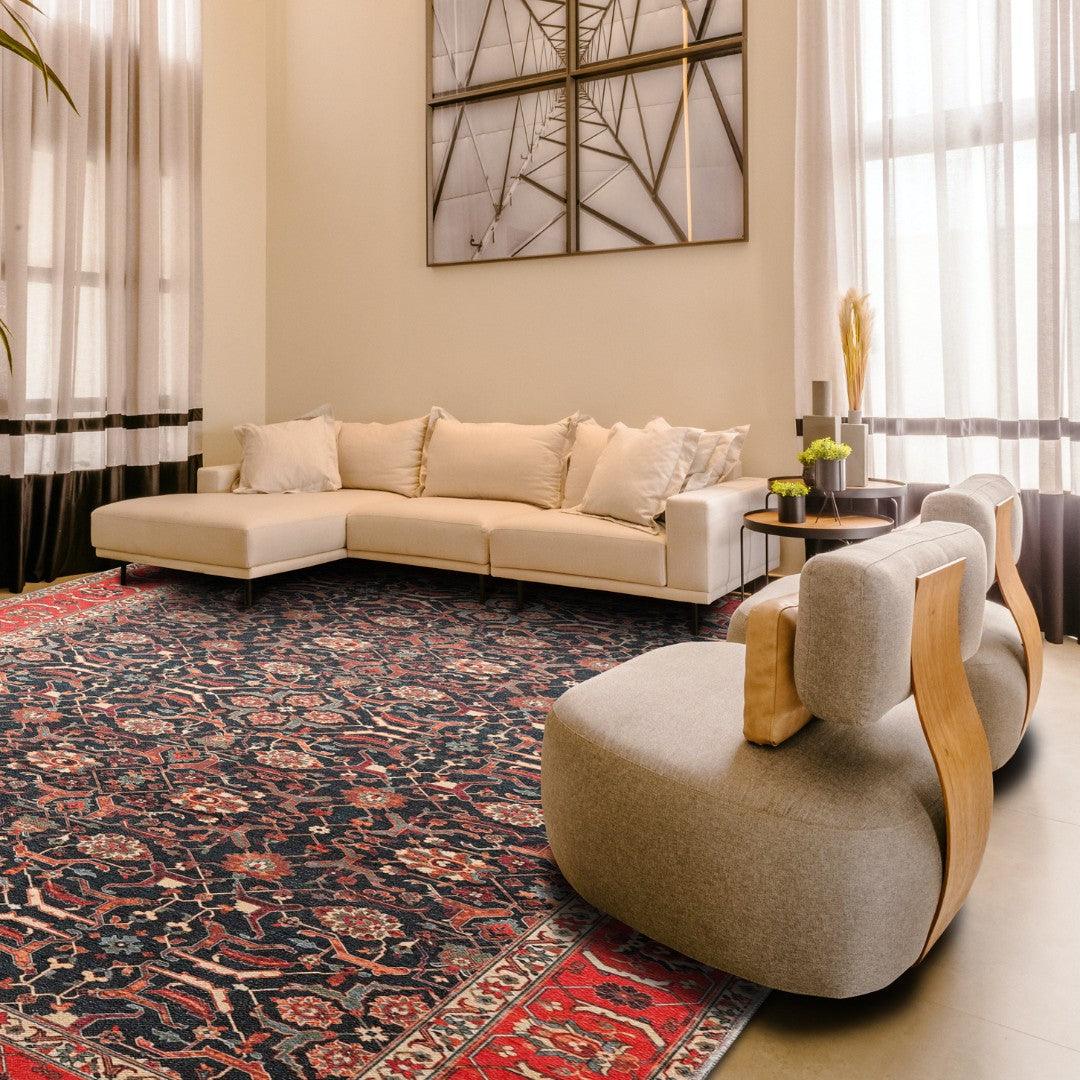






Most machine washable rugs up to 5'x7' will fit a standard 4.5 cubic foot home washer. The real limit is weight and drum space, not the label on the rug: aim for under about 15 pounds dry, and the rolled rug should fill no more than three quarters of the empty drum. Rugs 8'x10' and larger are too heavy for home machines.
The rule: weight first, then drum space
A washable rug behaves nothing like a load of shirts. It is one large, dense panel that soaks up several times its dry weight in water. A 13 lb rug can leave the wash cycle weighing 35 lb or more, and that mass has to tumble freely for the machine to actually clean it.
Two things decide whether that works. The first is dry weight — overload the drum and the rug just sits there, sodden, while the detergent never circulates. The second is free space. If the rug is packed in tight, the agitation that lifts dirt out of the pile never happens, and your machine will bang its way through an unbalanced spin cycle.
That is why we publish the actual weight of every rug size we sell rather than a vague “fits most washers” claim. Here are the real numbers.
Washable rug weights by size (real numbers)
These are dry weights taken from our own catalog across the flatweave washable range. Pile height and backing vary a little between designs, so treat them as a tight range rather than a single figure.
| Rug size | Typical dry weight | Minimum washer capacity |
|---|---|---|
| 2'x3' | 1.9–2.4 lb | Any washer, including compact 2.0 cu ft |
| 2'x6' runner | 3.5–4.0 lb | 2.5 cu ft and up |
| 3'x5' | 5.0–6.2 lb | 3.5 cu ft and up |
| 2'8"x8'2" long runner | ~6.3 lb | 3.5 cu ft and up |
| 4'x6' | ~7.4 lb | 4.0 cu ft and up |
| 5'x7' | 12.7–13.0 lb | 4.5 cu ft, front-load preferred |
| 8'x10' | 23.4–25 lb | Too heavy for home machines |
The jump from 5'x7' to 8'x10' is the one that catches people out. It is not a small step up — the rug nearly doubles in weight and moves firmly out of home-laundry territory. If you want a washable rug for a large living room, the honest answer is to plan around a commercial machine or to choose two smaller rugs.

What washer capacity actually means
Capacity is measured in cubic feet of drum volume, and it is printed on the model plate inside the door or on the back panel. Most full-size washers sold in the US sit between 4.0 and 5.0 cu ft. Compact and apartment-size units are usually 2.0 to 3.0 cu ft, and stacked laundry-closet machines often land at the lower end of that.
Front-load vs top-load
For rugs, the loading style matters as much as the number. Front-loaders tumble the rug end over end, which is gentle and lets water move through the whole panel. High-efficiency top-loaders without a center agitator work well too.
The one to avoid is an older top-loader with a tall central agitator. That post takes up drum space and rubs against the rug for the whole cycle — it is the fastest way to fray an edge or stress the backing. If that is the machine you have, stick to 3'x5' and smaller, or use a laundromat for anything larger.
How to check if your rug will fit: 5 steps
- Find your washer capacity. Look at the model plate inside the door or check the manual. Note the cubic feet.
- Weigh the rug. Stand on a bathroom scale holding the rolled rug, then subtract your own weight. Under 15 lb dry is the target for a full-size machine.
- Do the roll test. Roll the rug loosely and set it in the empty drum. It should fill no more than three quarters of the space, and you should be able to slide a hand down beside it.
- Wash cold on gentle. Cold water, delicate or gentle cycle, mild detergent. No bleach and no fabric softener — both attack the pile and the non-slip backing.
- Air dry flat. Lay it flat or drape it over a rail until fully dry. Heat is what causes shrinkage and backing damage, which is why we cover whether you can put a washable rug in the dryer separately.

What if your rug is too big?
You have three honest options, and none of them involve forcing a 25 lb rug into a domestic drum.
Use a laundromat. Commercial front-loaders run from roughly 6 to 8 cu ft and handle an 8'x10' without complaint. Same rules apply once it is in there: cold water, gentle cycle, mild detergent.
Spot clean and rotate. For a large rug in a low-traffic room, regular vacuuming plus prompt spot cleaning does most of the work. A full wash two or three times a year is often plenty.
Size down deliberately. Two 5'x7' rugs in a large open-plan space are far more practical than one 8'x10' you can never wash. If you are working out what size the room actually needs, our living room rug size guide walks through the layouts.
A note on the backing
The part of a washable rug most likely to fail in the wash is not the pile — it is the non-slip backing. Excess heat, bleach and fabric softener all break it down, and a cramped drum grinds it against the metal for an hour.
A rug pad takes some of that strain off in daily use by stopping the backing from being dragged across the floor, which means fewer washes and a longer life. We covered when one is worth it in do you need a rug pad for a washable rug.

Why we publish the weights
We work directly with the mills in Turkey that weave these rugs, with no importer in between, so we know what comes off the loom and what goes into the box. Publishing the real dry weight of each size is the simplest way to let you check a rug against your own machine before you buy, instead of finding out on wash day.
Every rug in our machine washable rug collection is woven from recycled fiber with a non-slip backing, and every size lists its weight on the product page. If you are still weighing up the format itself, are machine washable rugs worth it gives the honest pros and cons.
Written by the Arconiz team — we source handwoven and machine washable rugs direct from Turkish manufacturers, and we test every product we sell in our own homes.